A $6 fiberglass filter and a $28 pleated filter in the 12.5x21x4 size look nearly identical on the shelf. Drop them into the same HVAC system, wait eight weeks, and the differences show up in three places the store never mentioned: your electric bill, your blower motor, and the dust on your shelves. After manufacturing filters for more than a decade, we've watched this pattern play out in millions of homes. A homeowner saves twenty bucks at checkout, then pays it back four or five times over in higher energy bills, a harder-working blower, and indoor air that still carries the pet dander and pollen the cheap filter couldn't catch.
TL;DR Quick Answers
Cheap 12.5x21x4 filters save money at checkout and cost more everywhere else. Premium pleated versions (MERV 11 through 13) trap smaller particles, last three to six months, and keep your HVAC from overworking. The U.S. Department of Energy reports that clean filters cut HVAC energy use by 5 to 15 percent, which usually closes the price gap on its own. A cheap filter is only the cheap filter if you change it every 30 days. Most households don't. For homes with pets, allergies, asthma, wildfire smoke exposure, or a newer HVAC system, premium is the smarter buy, full stop. MERV 11 through 13 is the range most homes should target, assuming the system can handle it.
Top Takeaways
Because 12.5x21x4 isn't a big-box standard size, the quality gap between the cheapest and best filters is wider here than in common dimensions. Cheap options stick to thin fiberglass, low pleat counts, and weak frames. They'll catch lint, but they miss the smaller particles that actually matter for your family's health and your blower motor. Premium filters in this size step up to higher MERV, deeper pleats, three-to-six-month lifespans, and tighter frame seals that block bypass air. A dirty or underperforming filter can push HVAC energy use up 5 to 15 percent, per the U.S. Department of Energy. That turns the cheaper filter into the more expensive one as soon as you open your next utility bill. Cheap is only acceptable when you'll change it every 30 days without exception. Most households don't keep that discipline, which is where hidden costs pile up. Premium pays back fastest in homes with pets, asthma, allergies, wildfire smoke, or a newer HVAC system worth protecting. Before upgrading to MERV 11 or higher, confirm your HVAC manufacturer's maximum MERV rating so you don't restrict airflow.
The 12.5x21x4 size sits outside the standard big-box lineup. It's a less common, often custom-cut filter used in specific HVAC air handlers that need a 4-inch-deep media bed. Because most hardware stores don't stock it, quality and price swing farther in this size than in common dimensions like 16x25x1. Homeowners get surprised in both directions. Some buy cheap filters that barely work. Others pay premium prices for products that could have cost less from a direct manufacturer.
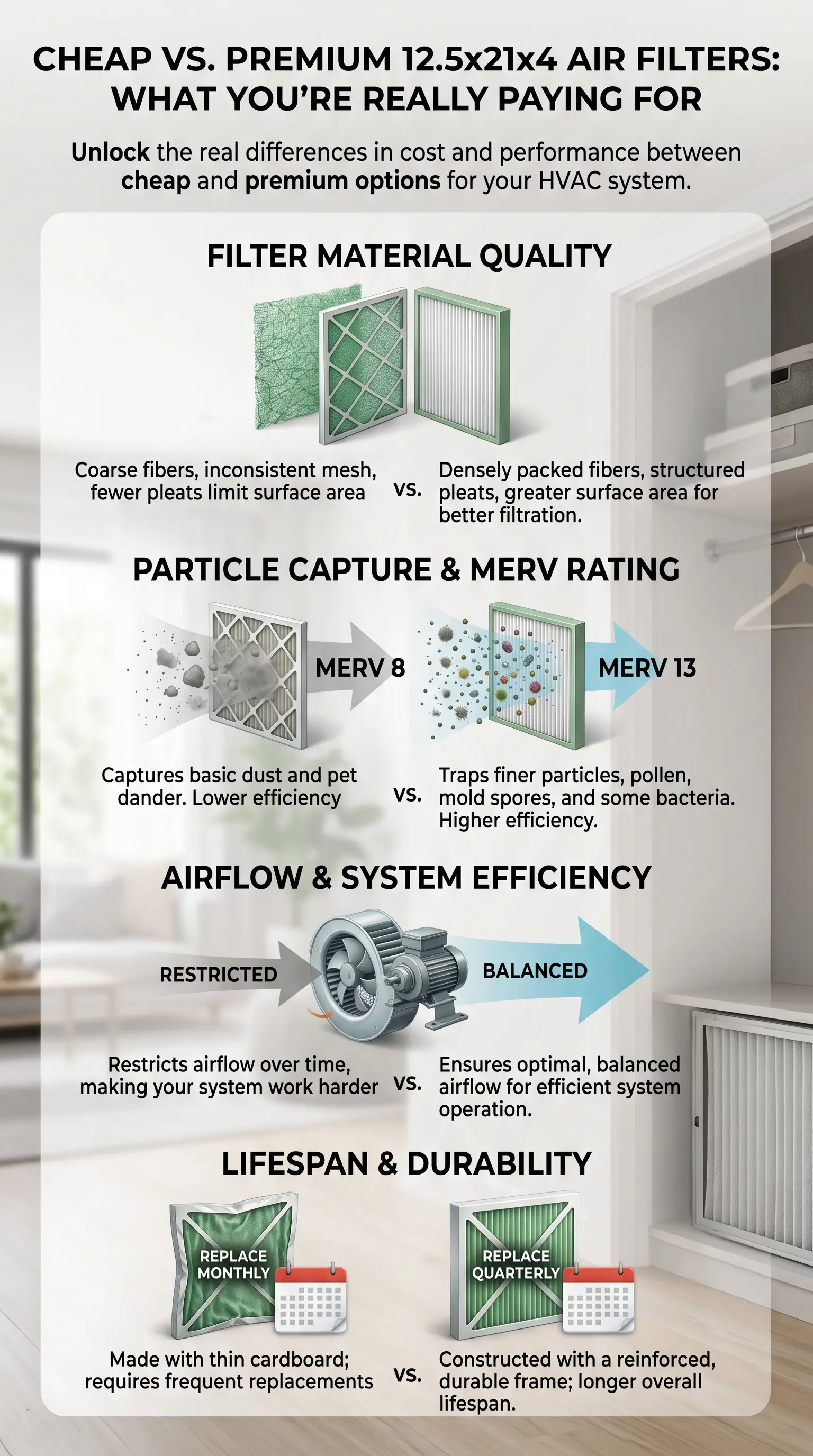
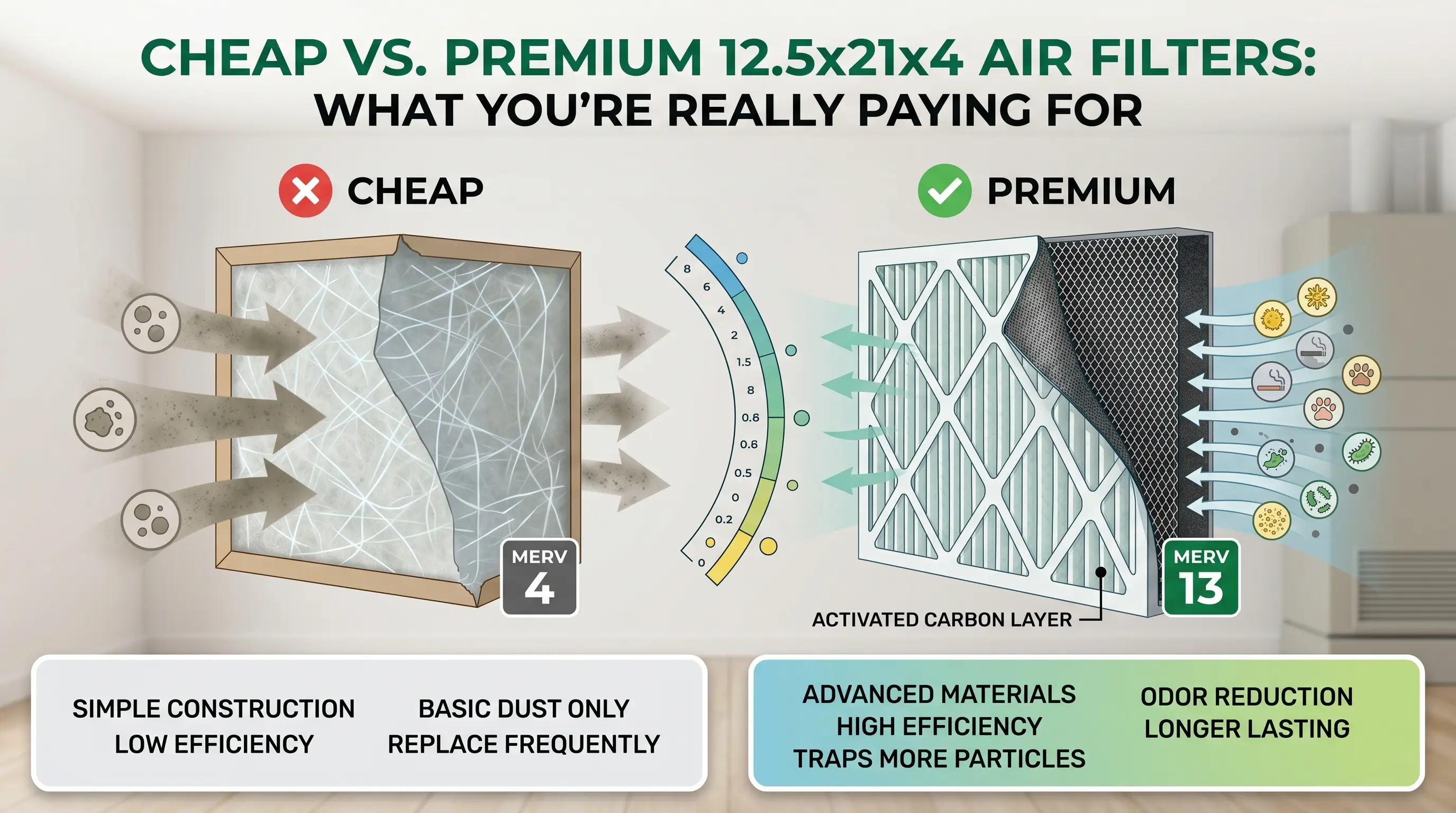
A budget 12.5x21x4 filter typically uses fiberglass or low-density synthetic media with minimal pleat surface area. The cardboard framing runs thin and can warp when humidity rises, and the frame seals stay loose enough to let unfiltered air bypass the media entirely. Most of these filters carry a MERV 4–6 rating, which means they catch mostly large particles like lint and visible dust. They do protect the blower from chunky debris. That's the extent of what they're actually doing. The particles that really affect your family's health, like pet dander, mold spores, pollen, and wildfire smoke, pass through as if the filter weren't there.
A premium filter in this size earns its price through specific upgrades you can measure. You're paying for a higher MERV rating, usually MERV 11 through 13, that captures particles as small as 0.3 microns. Deeper, tighter pleats give the filter more surface area and push its lifespan to three to six months. Rigid beverage-board or galvanized framing holds shape under pressure, and gasketed or heat-sealed edges stop bypass airflow. The result adds up to cleaner air, less strain on the blower motor, longer replacement intervals, and in many homes, lower monthly energy bills.
Here's the math most shoppers miss. A cheap $6 filter changed every 30 days runs about $72 a year, if you actually change it every 30 days. Most people don't. A premium $25 filter changed every four months runs about $75 a year for the filter alone. Along the way, it keeps the blower motor from overworking, cuts coil fouling that drags down AC efficiency, traps the particles that worsen allergies and asthma, and extends HVAC lifespan by years. Add in the energy savings from consistent airflow, and the premium filter usually pays for itself before the second change.
Premium isn't always the right call, to be fair. A basic 12.5x21x4 filter works fine in a vacation home or any rarely occupied space. It also holds up in households with no allergies, no pets, no indoor smokers, and a homeowner who genuinely commits to a 30-day replacement schedule. That's four conditions that all have to hold at once. When any one of them slips, premium earns its money back fast. That's especially true in homes with pets, allergies, or asthma, where the wrong filter shows up in flare-ups rather than utility bills. The same logic applies in wildfire regions, heavy-pollen zones, or any home with a newer HVAC system worth protecting. And if you'd rather swap a filter every four months than every 30 days, that single preference alone justifies the premium.
When you're ready to buy, start with your HVAC manufacturer's maximum supported MERV rating. Some older systems can't handle MERV 13 without restricting airflow. From there, pick pleated synthetic media over fiberglass, and buy from a manufacturer that specializes in custom filter sizes. This isn't a dimension to grab off a shelf and hope it fits. For a quality-built 12.5x21x4 filter made to exact specifications, you can shop 12.5x21x4 air filters directly from the manufacturer.
"After a decade manufacturing filters and working directly with millions of homeowners, we've watched the same pattern repeat: the cheap filter doesn't actually save money. It just moves the cost from the checkout line to the utility bill, and eventually to the HVAC repair invoice."
6 Essential Resources
These independent, trusted sources are worth bookmarking for any 12.5x21x4 filter decision:
U.S. EPA, Indoor Air Quality (IAQ) Overview: https://www.epa.gov/indoor-air-quality-iaq
U.S. EPA, The Inside Story: A Guide to Indoor Air Quality: https://www.epa.gov/indoor-air-quality-iaq/inside-story-guide-indoor-air-quality
U.S. Department of Energy, Air Conditioner Maintenance Guide: https://www.energy.gov/energysaver/air-conditioner-maintenance
ENERGY STAR, Heat & Cool Efficiently: https://www.energystar.gov/saveathome/heating-cooling
ENERGY STAR, HVAC Maintenance Checklist: https://www.energystar.gov/saveathome/heating-cooling/maintenance-checklist
National Institute of Environmental Health Sciences, Indoor Air Quality: https://www.niehs.nih.gov/health/topics/agents/indoor-air
3 Statistics You Should Know
1. Americans spend roughly 90% of their time indoors. The filter in your HVAC system is one of the most direct controls you have over the air your family actually breathes. Source: U.S. EPA, https://www.epa.gov/report-environment/indoor-air-quality
2. A clogged air filter can increase HVAC energy use by 5 to 15 percent. That adds up to a recurring line item on every future utility bill. The fix is simple: the right filter, changed on the right schedule. Source: U.S. Department of Energy, https://www.energy.gov/energysaver/air-conditioner-maintenance
3. Radon alone causes roughly 21,000 U.S. lung-cancer deaths each year, which shows how seriously the federal government treats indoor air pollutants that move through an HVAC system unfiltered. Source: NIEHS / U.S. EPA, https://www.niehs.nih.gov/health/topics/agents/indoor-air
Final Thoughts and Opinion
Here's our honest read after years of making filters and hearing from homeowners who use them. The "cheap versus premium" framing is misleading to begin with. The filter that fits your household is the right one, whatever the price tag says. A family with no pets, no allergies, and nobody home during the workday can genuinely get by on a basic fiberglass 12.5x21x4 filter, provided they change it every 30 days without fail. A family with a dog and a kid with asthma will come out ahead by paying more up front for a pleated MERV 11 or MERV 13. That filter matches the particle load their home actually produces. The worst decision in this size is buying the cheap one and forgetting about it. That's the scenario that quietly pushes energy bills 15 percent higher, grinds down the blower motor, and eventually produces an HVAC repair bill that costs more than a decade of premium filters put together. So here's our rule of thumb: if you can't promise yourself you'll change a cheap filter every 30 days, buy a premium one and change it every three or four months. You'll spend less money and breathe cleaner air. Filterbuy exists to give homeowners the knowledge to choose well and to make the invisible threats in their indoor air visible. The rest is your call.
Frequently Asked Questions
Is a 12.5x21x4 air filter a standard size? No. It's a less common, often custom-cut size. Because big-box stores rarely stock it, ordering from a manufacturer that specializes in custom sizes is usually the most reliable option.
How often should I change a 12.5x21x4 filter? Change cheap fiberglass 12.5x21x4 filters every 30 days. Premium pleated versions typically last three to six months, depending on pets, allergies, and HVAC runtime. Check the filter monthly either way.
What MERV rating is best for a 12.5x21x4 filter? MERV 8 handles general dust control. Most households with pets or mild allergies do better at MERV 11. For homes with asthma, allergies, or respiratory sensitivities, MERV 13 is the recommendation from organizations like the American Lung Association [VERIFY: ALA direct-source citation for MERV 13 recommendation], provided your HVAC system can support it.
Can I just use a cheap filter if I change it more often? Yes, but you're trading money for labor and filtration quality. A cheap filter changed every 30 days still captures fewer small particles than a premium one changed every 90 days. The dollar cost often lands in a similar range. The air quality doesn't.
Does a premium filter really lower my energy bill? It can. The U.S. Department of Energy estimates clean filters lower HVAC energy use by 5 to 15 percent. Premium filters hold consistent airflow longer between changes, which means fewer days of restricted airflow across a year.
Where can I buy a 12.5x21x4 air filter? Because this size isn't standard in most retail stores, your best bet is ordering directly from a manufacturer that specializes in custom sizes. Filterbuy builds this exact dimension to spec.
You're the one protecting what's downstream of that 12.5x21x4 slot: the air your family breathes, the blower motor pushing it around, and the monthly utility bill.
When you're ready to swap the cheap filter for one built to the exact size, Filterbuy makes this 12.5x21x4 filter in MERV 8 through MERV 13, American-made, and shipped directly to your door.
Shop 12.5x21x4 air filters. Little effort, big impact, better air for the people who matter most.
Learn more about HVAC Care from one of our HVAC solutions branches…
Filterbuy HVAC Solutions - Miami FL - Air Conditioning Service
1300 S Miami Ave Apt 4806 Miami FL 33130
(305) 306-5027
https://maps.app.goo.gl/Ci1vrL596LhvXKU79